
Product · Authorization artifacts
The record generates the documents. Not the other way around.
Every artifact CertiField produces is a rendering of the authorization record at a point in time. That is why regenerating one after a change is a routine operation rather than a rewrite — and why two artifacts generated the same day cannot disagree with each other.
- SSP
- SAR
- POA&M
- Authorization package
- OSCAL
- DOCX · PDF
- Ref
- P-31
- Kind
- SSP
- Grounded in
- the authorization record
- Tagged
- per-statement provenance
System Security Plan
Generate the SSP from current system facts: the categorization and its rationale, the system narratives, per-control implementation statements, the published architecture snapshot and the evidence linked to each control. Regeneration is reproducible — the same record produces the same document.
Each statement carries where it came from. A statement a person wrote is marked as authored; one accepted from an extraction proposal is marked as accepted and keeps its provenance; and if somebody later edits a generated statement, its tag changes to reflect that a human took ownership of it.
Bringing in the SSP you already have
Ingest DOCX, text-bearing PDF or plain text. Sections are classified by named rules, with AI assisting only on headings the rules could not resolve. Control implementations and narratives are extracted with the supporting quote attached, then reviewed and accepted — or not.
Nothing a parser or a model produces reaches the authorization record until a person with the authority to accept it does so.
- Ref
- P-32
- Kind
- SAR
- Grounded in
- the assessment record
Security Assessment Report
Turn assessment results, per-CCI test results and determinations into a SAR built from the assessment record — including which architecture version each assessment was performed against, so the report describes the system as it was when it was assessed rather than as it is today.
Findings carry their source. A finding that came from a scan names the scan; one that came from a checklist item names the checklist item; one an assessor raised names the assessor.
- Ref
- P-33
- Kind
- POA&M
- Upsert key
- external POA&M id
- Two-way
- Jira sync
Plan of Action and Milestones
Move findings into managed remediation with milestones, owners and dates, and keep the link back to the assessment and the source evidence intact. Because remediation work usually lives in Jira, CertiField syncs it two ways rather than asking engineers to update a second tracker they will forget about.
POA&M items imported from eMASS keep their external identifier as the upsert key, so a round trip does not create duplicates or orphan the item your reviewers already have open.
- Traceable back to the finding, the assessment and the evidence
- Synced with Jira so remediation state stays honest
- Round-trip safe against eMASS on the external identifier
- False-positive decisions survive the next scan or SBOM upload
- Ref
- P-34
- Kind
- Package
- Exporters
- control info · CCI results · POA&M · inventory
Authorization package
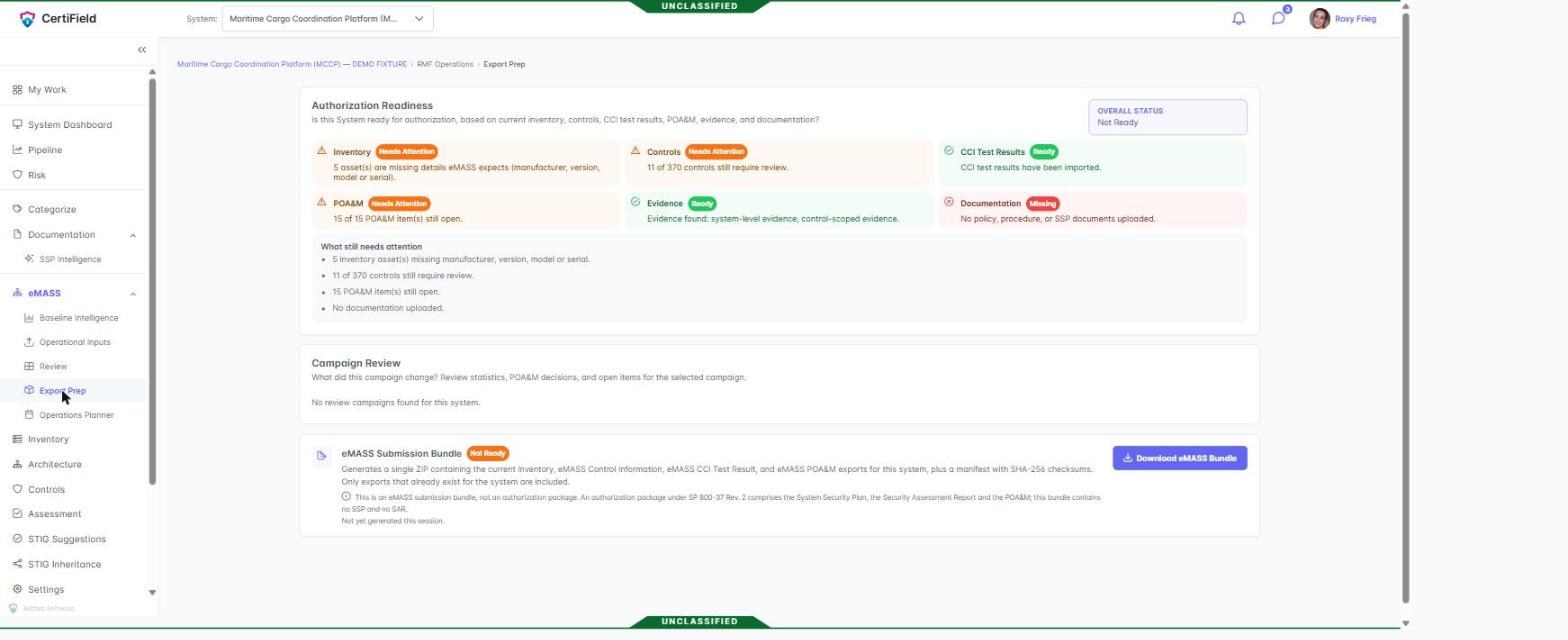
Before you assemble anything, CertiField tells you whether the system is ready: inventory, controls, CCI test results, POA&M, evidence and documentation each carry a readiness state, and what is outstanding is named item by item rather than reduced to a score.
Then assemble what you need. An authorization package under SP 800-37 Rev. 2 is the System Security Plan, the Security Assessment Report and the POA&M — CertiField generates all three from the record, so the package is a rendering of current state rather than a folder somebody collated by hand.
Where the destination is eMASS specifically, the eMASS submission bundle is a single ZIP carrying current inventory, eMASS control information, CCI test results and POA&M exports, with a manifest of SHA-256 checksums so the receiving end can verify nothing changed in transit.
- Ref
- P-35
- Kind
- OSCAL
- Catalog
- seeded from NIST OSCAL
- Artifacts
- SSP · SAR · POA&M
Human-readable when people need it. Machine-readable when systems need it.
The same authorization record exports as OSCAL — System Security Plan, Security Assessment Report and POA&M — for the systems that consume structured authorization data, and as DOCX and PDF for the reviewers who are going to read it on a screen and mark it up.
OSCAL also comes in. An existing OSCAL package can be imported to establish the record rather than re-keyed, which matters most for the programs that already have an ATO and no appetite for starting the paperwork again.
Why both formats, from one record
- Two audiences, one source of truth — the formats cannot drift apart
- The 800-53 Rev 5 catalog is already seeded from NIST OSCAL, so identifiers line up
- Provenance survives the export — a machine-readable artifact is still traceable
Next step