
Why CertiField · Human-governed AI
AI assists. Your people decide.
Every vendor in this market now has an AI badge. The question a government buyer should actually ask is narrower and much harder to answer well: what, exactly, is the machine allowed to change?
- AI proposes
- Evidence supports
- Practitioners decide
- CertiField preserves the record
- Ref
- W-11
- Kind
- Invariant
- Rule
- no machine writes a fact
- Enforced by
- test, not policy
The rule the product is built around.
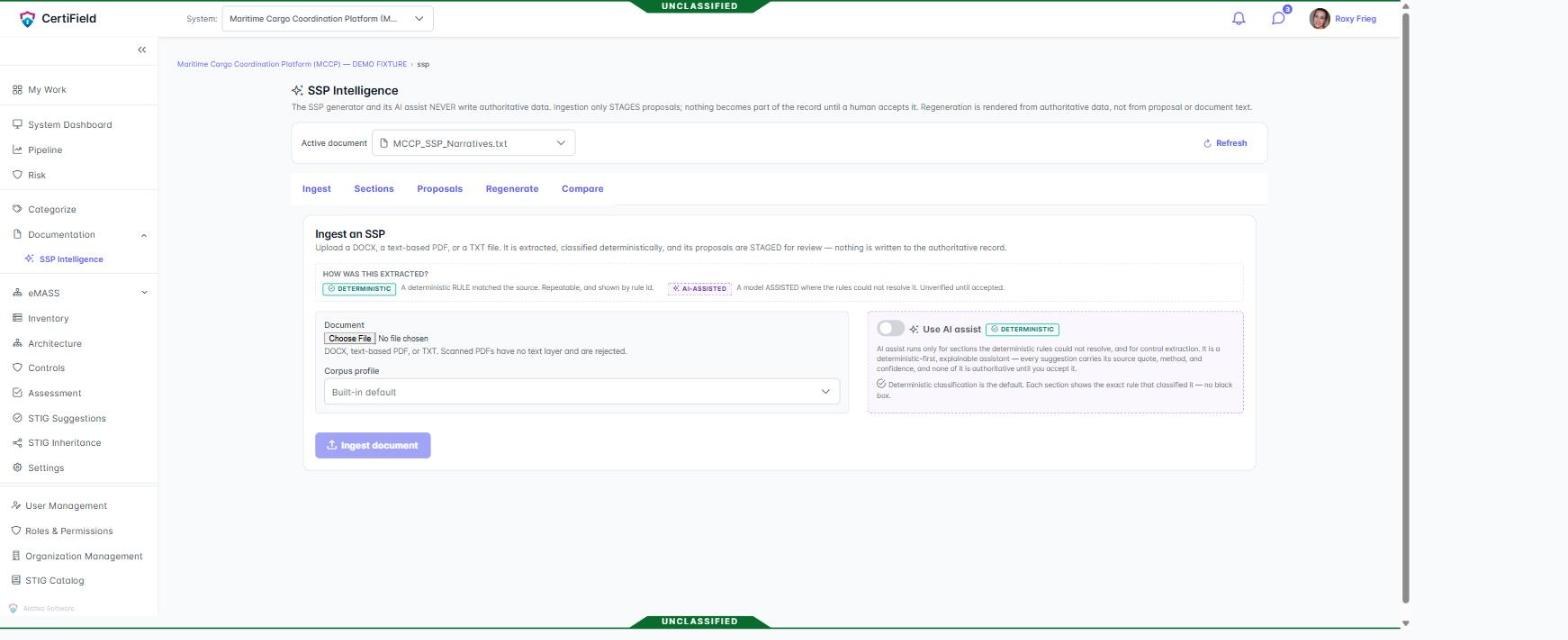
No importer, parser or model output mutates authoritative data.
Everything a machine produces in CertiField — a control implementation extracted from your existing SSP, a proposed architecture component, a STIG applicability ranking, a suggested control mapping — is a proposal. It carries its own explanation, including the quote it was drawn from where there is one. It stays a proposal until a person with the authority to accept it does so, and the acceptance is audited like any other authoritative act.
AI-derived architecture implications are explicitly advisory and cannot change controls, assessments, POA&M items or compliance determinations. That is not a setting. There is no code path.
- Ref
- W-12
- Kind
- Guards
- Fencing
- user content delimited
- Filtering
- server-side allowlists
What the model is structurally unable to do.
Invent an identifier
Control, CCI and STIG identifiers returned by a model are checked against the catalog server-side. An identifier that does not exist is discarded before anyone sees it, so a plausible-looking hallucination never becomes something a practitioner has to disprove.
Assert a security judgment
Architecture proposals are schema-validated against a closed taxonomy. The model cannot assert a boundary disposition, an encryption state or a data classification — those are the calls that decide an authorization, and they belong to people.
Take instructions from your documents
User content is fenced inside explicit delimiters on its way into the model, so text inside an uploaded SSP or scan report is treated as data to analyze rather than as instructions to follow.
Overwrite a newer human edit
A proposal records a hash of its target at the moment of extraction. If the target changed in the meantime, acceptance is refused as stale rather than clobbering the more recent decision.
- Ref
- W-13
- Kind
- Use
- Feature switches
- per capability
Where AI genuinely earns its place.
None of the above means AI is decorative here. It does the work that is genuinely tedious and genuinely low-stakes: reading a two-hundred-page SSP and finding the paragraph that discusses AC-2; ranking which of four hundred STIGs plausibly apply to a system running these technologies; drafting a first implementation statement from evidence a practitioner then corrects; noticing that a component moved and suggesting which controls that might touch.
Each capability has its own switch, subordinate to a master switch that can turn the lot off. And when it is off, it is off — no feature quietly keeps calling a provider that is not there.
The version of this that matters to a government buyer
"Powered by cutting-edge AI" is not a procurement argument. "The AI cannot change a determination, and here is the mechanism that makes that true" is.
How provenance is preserved →Next step