
DISA STIGs
STIG checklist management, without losing the work on every release.
There are several hundred DISA STIGs. A given system is subject to a small fraction of them, and the expensive part is not filling in the checklist — it is knowing which ones apply, and not starting over when DISA publishes a new version.
- CKL · CKLB
- Catalog sync
- Applicability ranking
- Merge on update
- Offline bundles
- Ref
- S-11
- Kind
- Applicability
- Ranked against
- real inventory
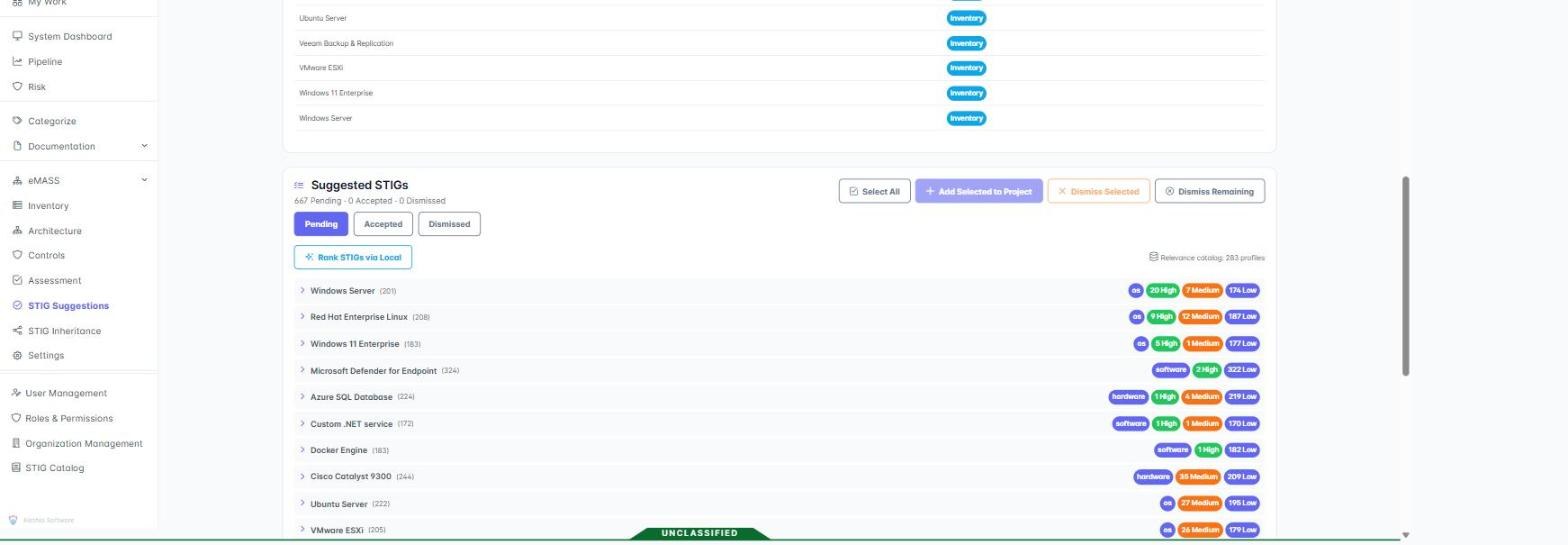
Which STIGs apply is a ranking problem, not a questionnaire.
Applicability should come from what the system actually runs — imported inventory plus the technologies your team recorded by hand — rather than from a form somebody filled in at kickoff and nobody revisited. When inventory drifts, applicability is re-derived.
And it arrives as a ranked suggestion a cyber engineer confirms, not a verdict. Nobody should be told a STIG applies; they should be told it probably applies, and why.
- Ref
- S-12
- Kind
- The three failures
Three ways checklist management goes wrong.
Guessing high
Claim more STIGs apply than really do, then mark most not-applicable. Enormously expensive, and it buries the ones that genuinely apply in noise.
Guessing low
A technology enters the inventory during a refresh, nobody re-derives applicability, and a STIG that should have been assessed simply never was. Nothing flags it.
Losing work on update
DISA publishes a new version and it replaces the checklist you already worked through. Status, comments and findings gone. This is a merge problem, not a replace problem.
- Ref
- S-13
- Kind
- Decisions
- Dismissal
- recorded with a reason
A dismissal is a decision, not a filter.
"This STIG does not apply to this system" is a judgment with an author and a reason. It should be stored as one — not applied as a view filter the next person does not know about, and cannot audit.
The same holds for a false-positive call on a scan finding. If that judgment lives on a row the next import recreates, it dies with the row and the finding silently returns unflagged. Decisions have to be keyed on what survives.
- Ref
- S-14
- Kind
- Disconnected
And in an enclave that cannot reach Cyber.mil.
Catalog bundles export and import by hand, and they carry the applicability relevance profiles with them — so a disconnected deployment running with AI switched off still gets ranking of the same quality. Isolation should not be the degraded mode.
Next step